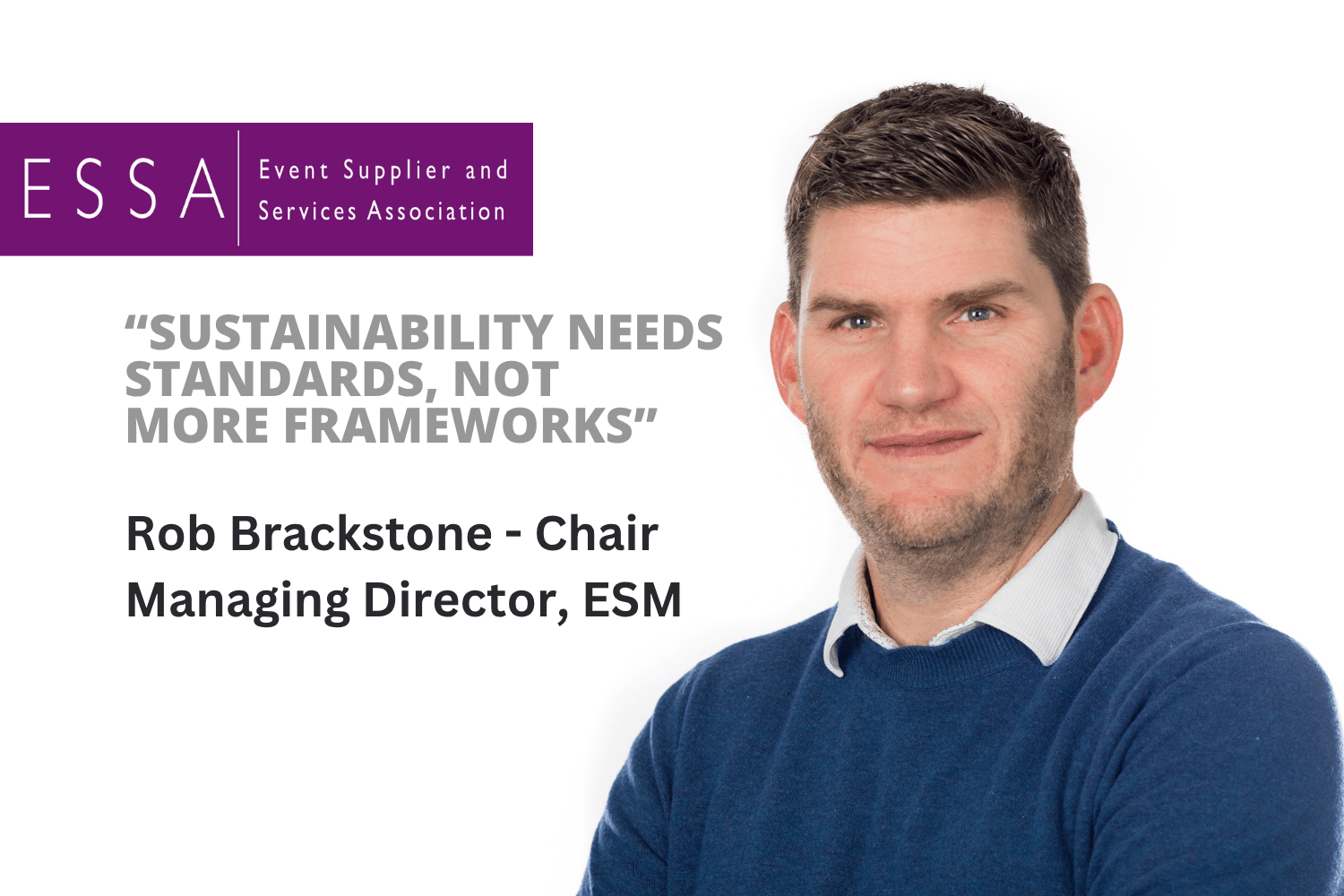
For more than thirty-five years I have designed and built exhibition stands. Over that time, I have watched the sector evolve enormously.
We have moved from hand-drawn visuals to CAD and fly-throughs; from stands designed for sheer presence to concepts created to drive ROI at every level of spend; and from talking about re-use for reasons of value and profit alone to serious conversations about circularity, materials and recycling. That progress is something our industry should be proud of.
Indeed, we have moved beyond ‘the stand’ to focus on our businesses as a whole, delving deep into every area of operations to find the marginal gains that add up to meaningful differences in sustainability. Let’s be honest. Anyone can design and build a stand or deliver a service that ticks all the relevant boxes. Anyone can talk the talk. It is acting on policies, embedding them into operations, and actually delivering on claims around recycling and re-use that really count.
We’ve come a long way as an industry - further, probably, than the majority of our international peers. So why then, despite all that progress, do we still find it so difficult to align behind a single, credible sustainability standard?
As someone who still builds stands and now happens to chair the Event Supplier and Services Association (ESSA), I see the same pattern repeating. Every few months a new initiative appears. A new framework. A new measurement tool. A new certification badge. Each suggests the previous solution was somehow incomplete.
For those that gain any traction, the supply chain is then asked to comply. Again and again.
For example, a contractor or agency will have their own sustainability framework. A corporate client will have theirs, which contractors must align with at the point of pitch. An organiser will have another set of proposals that must be aligned with and, at times, be assessed against. Then there are additional frameworks competing for attention, alongside commentary and, occasionally, headline-driven examples that do not always reflect the reality of UK operations.
A confusing landscape of sustainability claims and counterclaims can quickly become the norm.
Contractors are then repeatedly asked to input data into another portal, validate through another audit, subscribe to another calculator, and chase another certificate — all in the name of progress.
Let me be clear. I am not arguing against measurement. Quite the opposite.
As a contractor responsible for designing and building stands, transporting them, powering them, dismantling them and managing post-show storage — all while overseeing our own supply chain — I know measurement is essential. You cannot reduce what you do not quantify.
But the exhibition sector is not starting from zero.
ESSA established its sustainability accreditation framework years ago, developed with supplier input and grounded firmly in operational reality. It was designed specifically for exhibition contractors and suppliers, not retrofitted from another industry.
The framework requires independent annual assessment and continuous improvement across carbon measurement, materials use, waste performance, energy consumption, logistics and governance. Members must provide evidence, not simply statements of intent, and demonstrate year-on-year progress through tiered accreditation levels.
Many of our members are now several years into that journey. They have embedded carbon accounting into their operations, developed reduction roadmaps, adjusted procurement strategies and invested in training and operational change.
Alongside this, ESSA provides a sector-specific carbon calculator aligned with how exhibition contractors actually work. It is not perfect — no measurement tool ever is — but it is practical, accessible and grounded in the realities of exhibition delivery.
More broadly, the capability to measure sustainability in live events absolutely exists. The tools exist. The knowledge exists. The will exists.
So the question I keep coming back to is simple: why do we keep reinventing the wheel?
In thirty-five years in this industry, I have learned that consistency drives performance.
When we agree on structural standards, we build to them. When we agree on electrical regulations, we comply with them. We do not rewrite those rulebooks every quarter.
Yet when it comes to sustainability, the sector continues to fragment.
It remains a frustration to me that our sister associations, the Association of Event Venues and the Association of Event Organisers, did not formally align behind ESSA’s sustainability framework when it was first launched.
Had the sector moved together at that point — unified behind tools adopted by those delivering services on the ground — we would now have years of consistent and comparable data across the supply chain. We would have a unified baseline from which to demonstrate genuine progress. Instead, we are at risk of layering initiative upon initiative.
ESSA has, at every step, worked to drive alignment with its sustainability accreditation wherever possible. From the outset, it has aligned with recognised industry standards, including ISO frameworks such as ISO 14001 and ISO 20121.
ESSA has also supported initiatives such as Better Stands, recognising that while assessing individual stand builds has value, understanding the broader sustainability of a business provides deeper insight. Through ongoing participation in working groups, ESSA has sought to align elements of its accreditation with complementary industry initiatives.
We have also engaged beyond the sector, including discussions with platforms such as EcoVadis. Like many contractors, we have had to pursue additional accreditations to meet client requirements — often building on the work already undertaken through ESSA.
My point is that every additional framework brings additional cost: audit fees, consultancy, software platforms, staff time and internal process changes. For large contractors, those costs are significant. For SMEs — which represent a large proportion of our sector — they can quickly become burdensome.
If that trend continues, the supply chain will inevitably have to pass those costs on. That means higher exhibitor costs, higher organiser costs and greater friction in an already margin-sensitive industry.
There is also an uncomfortable truth worth acknowledging. Whenever new standards are introduced, new commercial ecosystems tend to follow — certification schemes, reporting platforms and subscription services. That is not inherently wrong. However, it does create an incentive to introduce something new rather than strengthen what already exists.
From a contractor’s perspective, we have yet to see anything that demonstrably surpasses the robustness and sector specificity of ESSA’s accreditation framework. That is not bravado, it is a practical assessment based on what our members are required to evidence every year.
The accreditation continues to evolve, supported by resources provided as part of ESSA membership to help organisations progress through the tiers and strengthen their sustainability performance.
The journey to net zero, credible ESG reporting and genuine circularity does not need to be complicated. What it requires is alignment, consistency and leadership across the industry.
As someone who understands how complex our work already is — coordinating multiple stakeholders to deliver successful builds — my request is a simple one: let’s focus on pragmatism.
Let’s stop reinventing the wheel. Stop resetting the goalposts for the supply chain every few months.
If the industry wants a working framework with progressive accreditation, independent assessment and real operational relevance, ESSA is ready to work collaboratively to strengthen and expand what already exists — complementing the good work of others and driving alignment wherever possible.
Because if we cannot find alignment soon, we risk not only increasing costs but weakening the credibility of the sustainability progress we are all trying to achieve, while continuing to fragment the landscape with new competing approaches.
After thirty-five years of building stands, I know this industry works best when we agree the standards and then get on with the job.