The exhibition supply chain does not need another carefully chosen label. It needs earlier involvement, fairer working conditions and clear evidence that partnership means something when real decisions are being made.
We use the word “partner” a lot in our industry. It appears in presentations, proposals, panel discussions and carefully polished company values.
But what does it actually mean?
At the IFES World Summit in Munich earlier this summer, one exchange brought that question into sharp focus for me. A discussion turned to the relationship between suppliers and service providers, venues, organisers and exhibitors. It was a good session, full of the optimism our sector is fond of when we get in a room together.
But one moment has stayed with me.
A proposal was floated to rename - almost rebrand - suppliers and service providers as “partners”. One stakeholder group represented on stage had already adopted the term.
The response from the service provider sharing the platform was refreshingly candid. Paraphrasing him as fairly as I can: he did not care what they were called, as long as there was genuine meaning behind it.
Respect. Understanding. Being seen, included and listened to. That matters far more than a new label stitched onto an old relationship.
And he is right. And it is worth saying plainly, even from where I sit; there is good and better in every stakeholder group in our industry. None of us gets to claim the moral high ground.
But the broader sentiment in that room, and in every similar room I have sat in over the past few years, is the same.
The supply chain is not asking to be called a “partner”. It is asking to be treated like one.
It wants actions over words.
That session was really probing the unique buying reason for our sector, with a sharp focus on the exhibitor. I have written before about the need to understand our industry’s equivalent of Five Guys’ famously overflowing fries - the visible sign of value that customers immediately recognise and remember.
What is the thing that actually keeps people coming back to events?
Here is where I will declare my bias, because you would expect nothing less from someone in my chair. Once an exhibitor has committed to a particular show, their choice over the venue and many of the services attached to it can be extremely limited. They have more choice over whether to exhibit at all, and which show in their sector to back.
But the supply chain exists to deliver one of the most important assets any exhibitor brings to a show - its visible presence. In this case that is not a minor supporting role. It is a central part of the product. And yet I keep seeing attempts to erode the free thinking that built this industry, replacing it with standardised, off-the-shelf solutions designed to hit commercial targets.
Shorter tenancy windows. Standardised footprints. The comforting language of “sustainability” used to justify decisions where the environmental benefit is not always clear, but the commercial benefit is much easier to see. We should be honest about that.
The customer or consumer - the visitor walking the aisles - will ultimately decide whether they are enjoying the experience. A flattened, commoditised show floor is not what keeps them coming back. We are a creative industry. The supply chain is a significant, if not the most significant, part of the answer to that unique buying reason.
But I would say that, wouldn’t I?
Here is where words give way to actions, because this is where I would ask the sceptics to look at what has actually been done.
Across the world, supplier and service provider associations and their members have spent the past several years investing - not simply talking about - in higher standards rather than waiting to be told to improve.
Look at the work around sustainability reporting, carbon measurement, reusable systems, safety standards, accreditation, training and skills development.
These things were not built for a press release. They were built because the people doing the work decided the bar needed to move forward - so moved it themselves.
None of that needed a new name. It needed people showing up and doing the unglamorous work of getting better. So when the next summit panel turns, as it inevitably will, to language, to what we call each other and to the optics of partnership, I will be listening for something else entirely. Not the term we land on, but whether the actions underneath it have changed. Respect does not arrive through a rebrand.
It arrives when an organiser changes a tenancy window because the original schedule puts people’s wellbeing at risk.
It arrives when a venue adapts an access process because it is the right thing to do, rather than the easiest.
It arrives when the supply chain is included early enough to shape decisions, not simply asked to deliver them once they are effectively irreversible.
Partnership is not something any organisation can declare by itself. It is something other people recognise through how they are consulted, included and treated, even more so when time is tight, pressure is high and the commercially convenient answer is not necessarily the right one.
There is plenty of good work happening across our industry, and plenty we can build on. But we should also be honest about where the gaps remain.
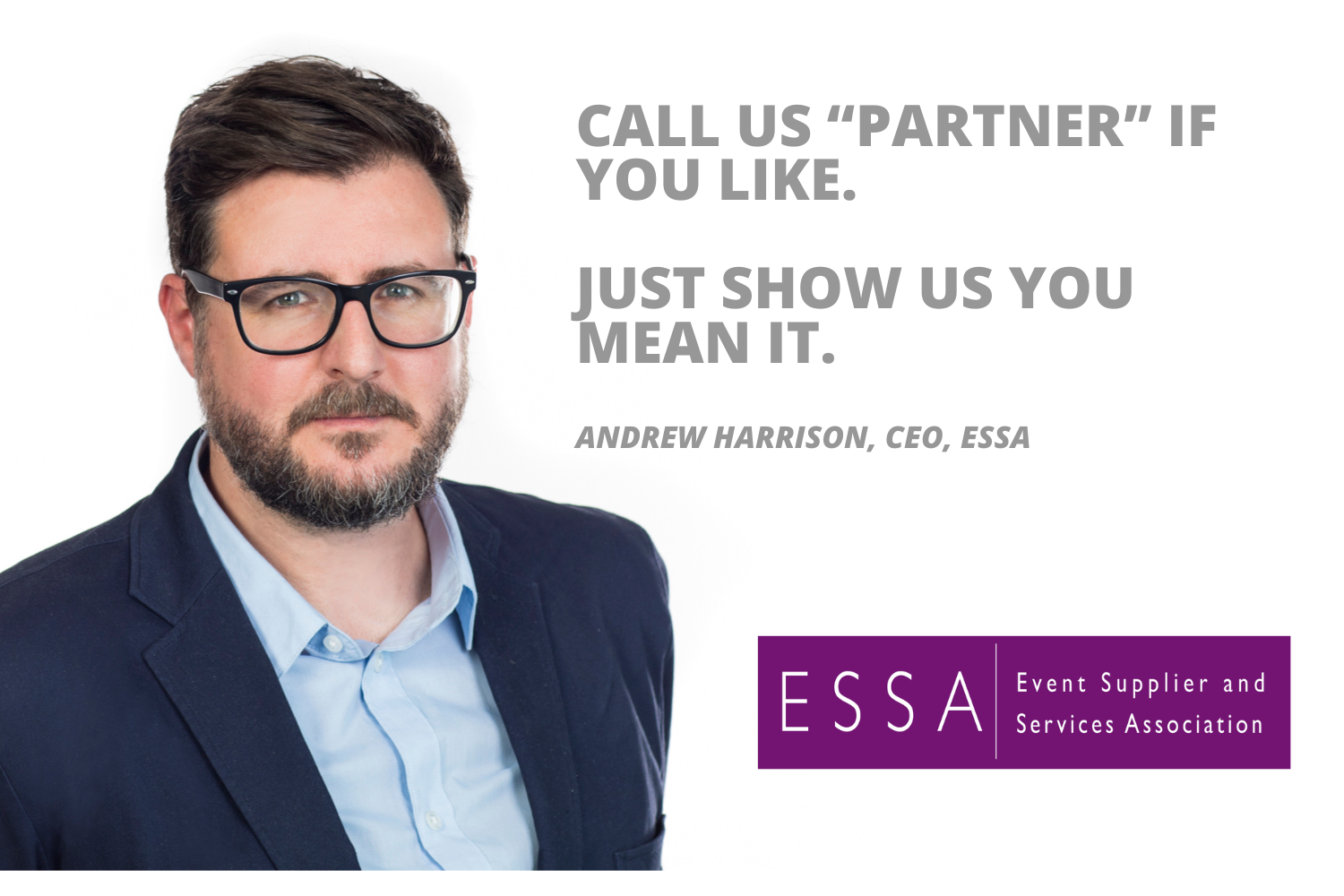
Call us “Partner” if you like. Just show us you mean it.
Andrew Harrison, CEO, ESSA